
Do I Really Need a Voltage Stabilizer for My AC? The Complete Guide
This is the most asked question by AC buyers in India in 2026 — and for good reason. You just spent Rs. 35,000 to Rs. 60,000 on a brand new air conditioner. The dealer says you need a stabilizer. The AC box says ‘stabilizer-free operation’. Your neighbour says it is not needed anymore. So who is right?
The honest answer: it depends on where you live and what type of AC you have. This guide gives you the exact answer for your situation — no guesswork, no sales pitch.
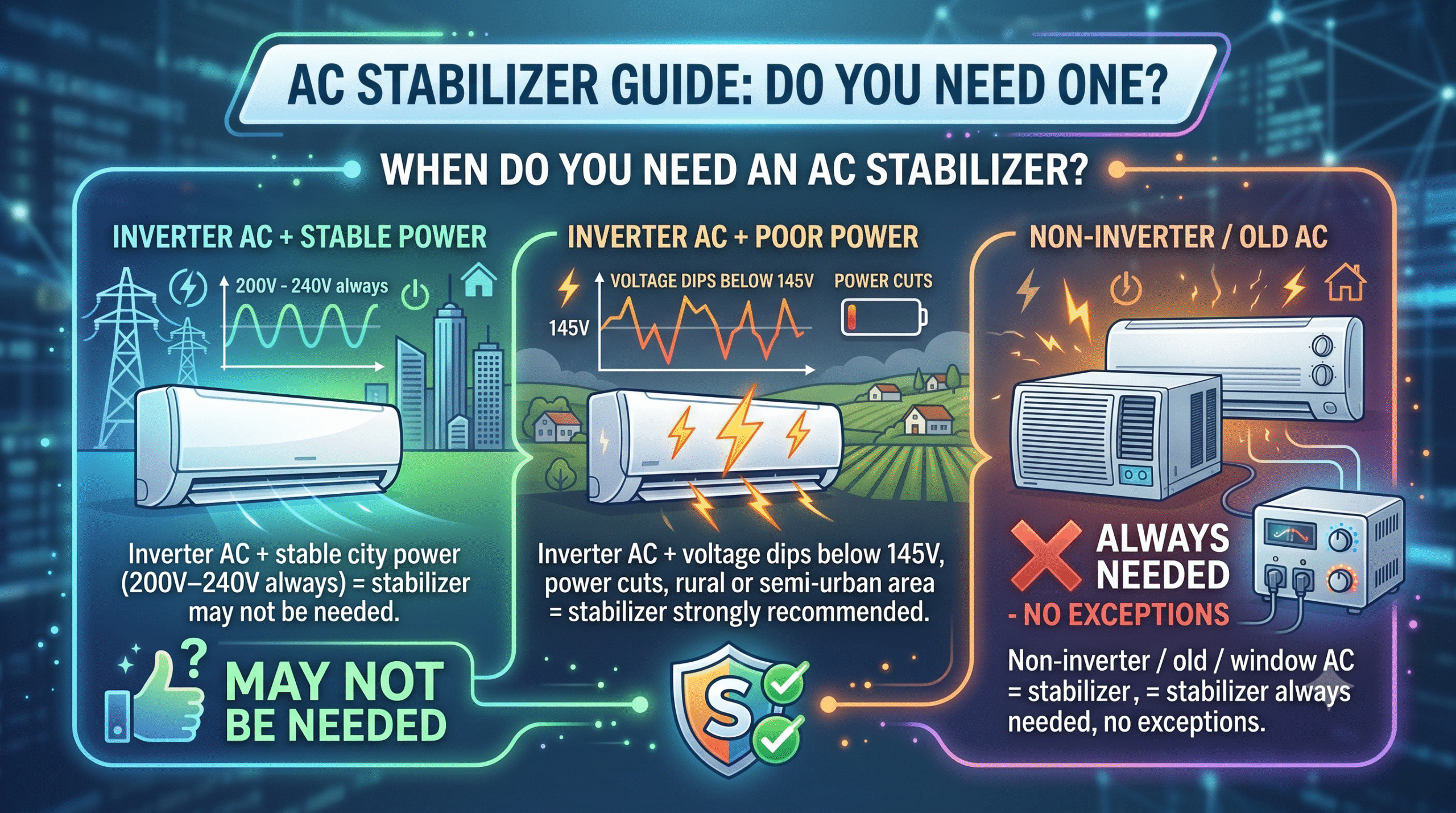
| Quick Answer: Inverter AC + stable city power (200V–240V always) = stabilizer may not be needed. Inverter AC + voltage dips below 145V, power cuts, rural or semi-urban area = stabilizer strongly recommended. Non-inverter / old / window AC = stabilizer always needed, no exceptions |
What Does a Voltage Stabilizer Actually Do?
Before answering whether you need one, it helps to understand what a stabilizer does in 30 seconds.
Your home electricity supply is supposed to be 220–240V at all times. In reality, in most Indian cities and towns, the voltage bounces constantly — especially during summer peak hours, evening load, or after a power cut restoration.
A voltage stabilizer sits between the main power socket and your AC. It monitors incoming voltage every fraction of a second and:
- Boosts the voltage if it drops too low (e.g. 160V → corrects to 220V)
- Reduces the voltage if it goes too high (e.g. 270V → corrects to 220V)
- Cuts off power completely if voltage goes dangerously out of range
The result: your AC always receives clean, stable power — regardless of what is happening in your electricity grid.
The Big Change: Why Inverter ACs Changed Everything
Ten years ago, every AC needed a stabilizer without question. Older fixed-speed (non-inverter) ACs were built to work only within a very narrow voltage band of 180V–250V. Any fluctuation outside this range meant compressor stress, shutdowns, or damage.
Then inverter ACs arrived and changed the game. Most inverter ACs made after 2018 come with built-in voltage regulation that can handle input voltages between 140V and 290V — a much wider range that covers most fluctuations in Indian metro cities.
This is what ‘stabilizer-free operation’ printed on your AC box actually means: the AC has internal circuitry that can handle moderate voltage changes without needing an external device.
| Important: ‘Stabilizer-free’ does NOT mean ‘voltage-damage-proof’. It means the AC can tolerate a range on its own. Outside that range — or during sudden power surges — the internal protection can and does fail. |
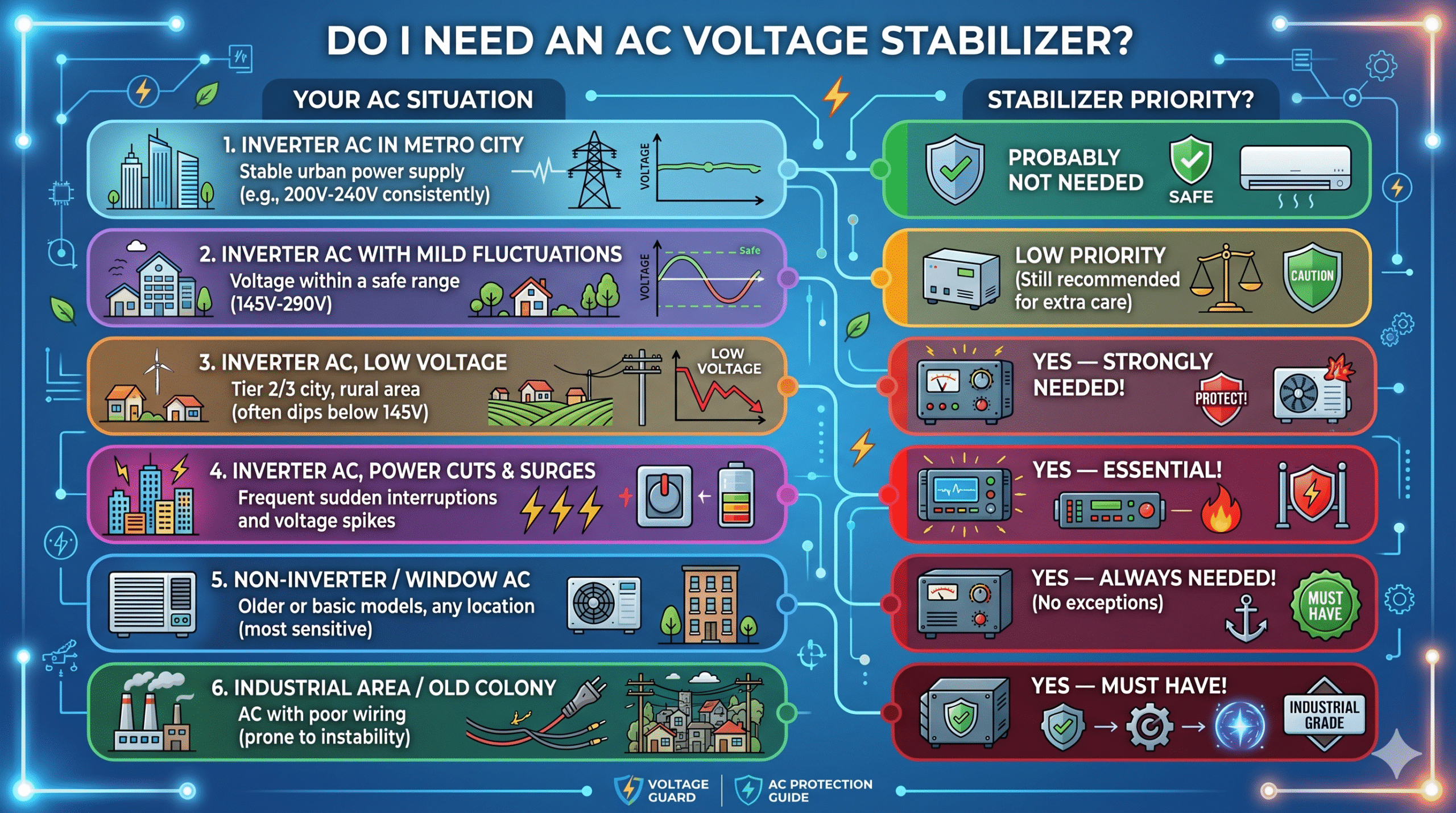
The Honest Decision Table: Do YOU Need a Stabilizer?
Use this table to get your answer in 10 seconds:
| Your Situation | Do You Need a Stabilizer? |
| Inverter AC, stable metro city supply (200V–240V consistently) | Probably NOT needed |
| Inverter AC, mild fluctuations but within 145V–290V | LOW priority |
| Inverter AC, voltage often dips below 145V (Tier 2/3 city, rural) | YES — strongly needed |
| Inverter AC, frequent sudden power cuts and surges | YES — essential |
| Non-inverter / window AC — any location | YES — always needed |
| Any AC in industrial area or old colony wiring | YES — must have |
Not sure what your voltage situation is? Here is how to check in 2 minutes: buy a simple digital voltage meter from any hardware shop for Rs. 200–500, plug it into the socket near your AC, and read the display in the morning, afternoon, and evening. If you see readings below 180V or above 260V regularly — you need a stabilizer.
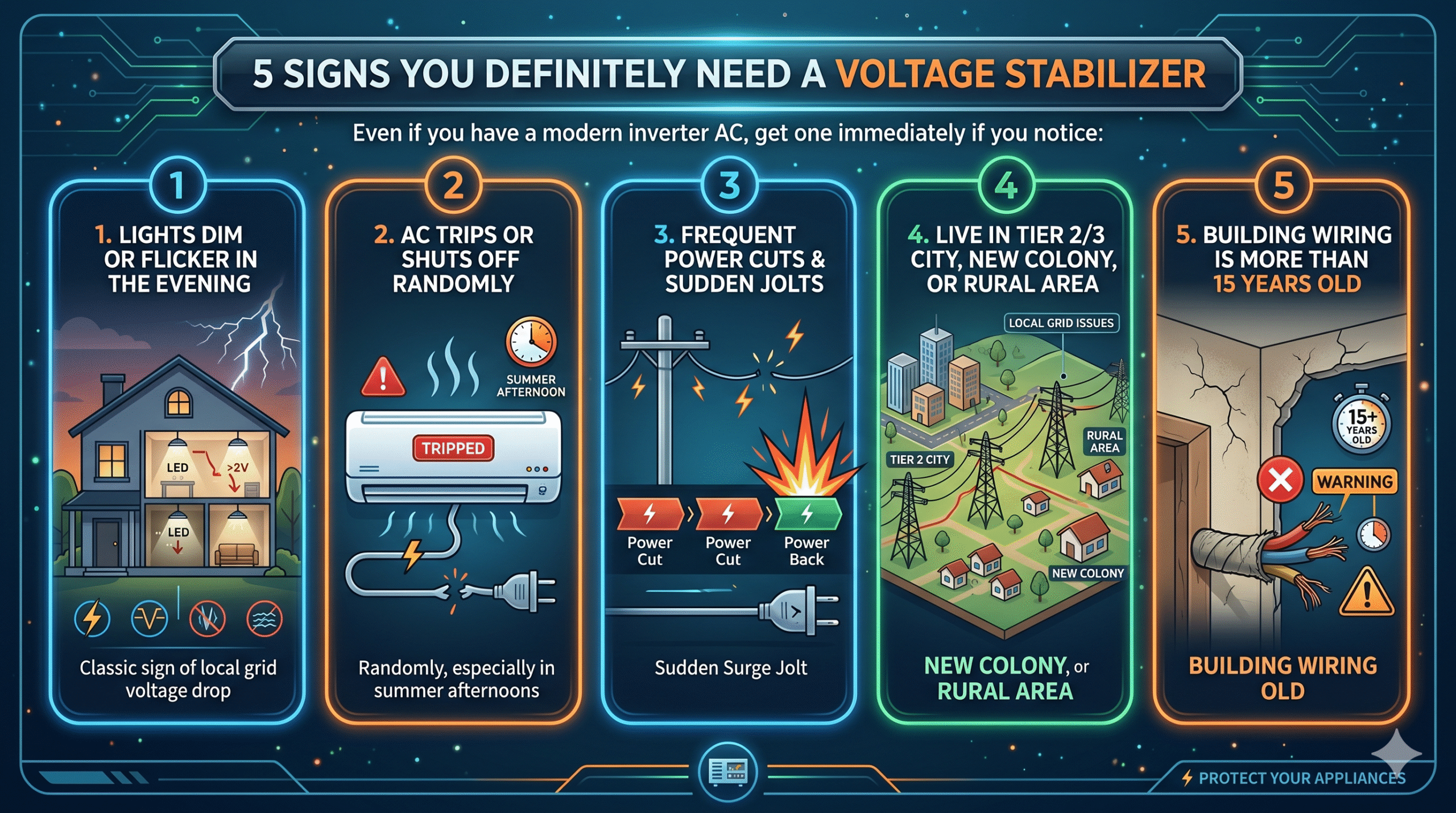
5 Signs You Definitely Need a Voltage Stabilizer
Even if you have a modern inverter AC, you should get a stabilizer immediately if you notice any of these signs:
- Your lights dim or flicker in the evening — this is a classic sign of voltage drop on your local grid
- Your AC trips or shuts off randomly, especially in summer afternoons
- You have frequent power cuts and your power comes back with a sudden jolt
- You live in a Tier 2 or Tier 3 city, a new colony, or a rural area
- Your building wiring is more than 15 years old
| Real story: A brand-new inverter AC with built-in stabilizer and ‘stabilizer-free operation’ label had its compressor and PCB both destroyed by a sudden power surge in a Kanpur neighbourhood. The neighbouring room’s older AC, connected to an external stabilizer, was completely safe. The repair bill was Rs. 18,000 — not covered under warranty because it was voltage damage. |
What Happens When You Don’t Use a Stabilizer (The Real Costs)
Here is the cost comparison that makes the decision very simple:
| Without Stabilizer | With Stabilizer | |
| AC compressor repair cost | Rs. 12,000–25,000 | Rs. 0 |
| PCB replacement cost | Rs. 8,000–15,000 | Rs. 0 |
| AC lifespan | 6–8 years | 12–15 years |
| Stabilizer cost (one-time) | — | Rs. 2,000–5,000 |
| Annual extra electricity cost | — | Rs. 1,500–4,200 |
The math is clear. A voltage stabilizer costs Rs. 2,000 to Rs. 5,000 once. A single compressor failure costs you Rs. 12,000 to Rs. 25,000 — and that is not covered under AC warranty if voltage is the cause.
But My AC Says ‘Stabilizer-Free Operation’ — Is It Really Safe?
This label causes more confusion than anything else in the AC industry. Here is the truth broken down simply:
What the label actually guarantees:
- The AC can handle voltage within its rated range (typically 145V–290V) without an external stabilizer
- The internal components are designed to manage moderate fluctuations
What the label does NOT guarantee:
- Protection against voltage drops below 140V (very common in many Indian areas in summer)
- Protection against sudden voltage spikes above 290V from power restoration after a cut
- Protection against sustained low voltage which slowly burns the compressor over months
- Any warranty coverage if voltage-related damage occurs
Leading AC brands including Haier officially state that even their ‘stabilizer-free’ models benefit from an external stabilizer in areas with unstable power, and that using one protects your warranty claim from being disputed.
How to Choose the Right Stabilizer (Quick Guide)
If you have decided you need one, here is how to pick the right stabilizer without getting confused:
- Match the KVA rating to your AC size — 4 KVA for 1.5-ton AC, 5 KVA for 2-ton AC
- Choose a wide input voltage range — look for 130V–290V or wider for Indian conditions
- Prefer a digital display so you can see live incoming voltage anytime
- Check the warranty — a good stabilizer should come with at least 3 years warranty
- Buy a branded stabilizer from Hypher
| Pro tip: The stabilizer should be installed by an electrician on a dedicated circuit for the AC. Do not share the same power line as other heavy appliances like geyser or washing machine. |
Frequently Asked Questions
Q: Can I use the same stabilizer for two ACs?
No. Each AC should have its own dedicated stabilizer rated for that AC’s capacity. Sharing one stabilizer between two ACs overloads it and defeats the protection it provides.
Q: Does the stabilizer consume extra electricity?
Yes, but minimally. A typical AC stabilizer draws 30 to 100 watts of power — which adds approximately Rs. 1,500 to Rs. 4,200 to your annual electricity bill. Compared to the cost of even one compressor repair, this is negligible.
Q: Where should the stabilizer be installed?
The stabilizer should be installed on the wall near your AC indoor unit, in a well-ventilated spot. It should not be enclosed in a cabinet or placed in direct sunlight. Most stabilizers come with mounting brackets.
Q: My AC is under warranty — does not having a stabilizer void the warranty?
It depends on the brand. Most major brands explicitly state in their warranty terms that voltage-related damage is excluded. If your AC is damaged due to voltage fluctuation and you did not have a stabilizer, the brand can and will refuse the warranty claim.
Q: How long does a voltage stabilizer last?
A good quality stabilizer from a reliable brand lasts 8 to 12 years with minimal maintenance. It is a one-time investment that protects your AC through its entire lifespan.
Final Verdict: Should You Buy a Voltage Stabilizer?
Here is the simplest way to think about it:
- If you live in a major metro city, have a 2019+ inverter AC, and your voltage is consistently between 200V–240V — you can skip the stabilizer for now. But check your voltage first before deciding.
- If you live anywhere in India where power cuts happen, voltage dips below 180V, or your area has any kind of grid instability — get a stabilizer. No debate.
- If you have a non-inverter or window AC — get a stabilizer right now regardless of where you live.
A voltage stabilizer is not just an accessory. It is the cheapest insurance policy you can buy for your most expensive home appliance. The Rs. 3,000 you spend today could save you Rs. 20,000 in repairs tomorrow.
| Protect your AC today. Browse our range of voltage correctors specifically designed for air conditioners — with wide voltage ranges, digital displays, and 3-year warranty. Made for Indian power conditions. |
— End of Article—